We set off from Salen early the next morning, bound for Tobermory and it's brightly painted houses. It was a grey and dank sort of a day, but on arrival at Mull's capital we were able to have showers and do laundry at the excellent facility set up by the Crown Estate for yachtsmen. A foray into the town followed, the Skipper noting with pleasure that many of the establishments (including the redoubtable 'Mishnish' pub) were still there since his last visit during West Highland Yachting Week in 1999. The ship was re-provisioned, and petrol for the outboard bought at the local gas station. We also had a good 'swatch' at the only hardware shop in town, and came away dumbfounded as to how expensive it was. Everything, and I mean everything, was at least 2 times and often 3 or even 4 times the price it is on the mainland. Looking for some yacht varnish, the Skipper could only locate exterior (inferior!) varnish for £30 for a litre!!!! Gas cannisters were also £6 each...strangely enough, a litre of proper yacht varnish was found in the chandlers next door for £12, along with gas for £2 each...hmmm.
With the Good Ship re-watered and foodstocks replenished, we set off mid-afternoon into a light breeze, the plan being to aim for Bunessan for the night all the way down the other side of Mull. It was slow going at first, but the monotony was soon broken by cries from Seaman Finnegan - SHARK!!!
Surely enough, first one and then another basking shark hove into view, their dorsal fins glinting in the afternoon light. We watched them for a while, before turning our attention back to the sailing. The Skipper retired below for a nap when a few minutes later the next call rang out - WHALE!!!! A small whale was in the water off the port bow, although it kept its distance as we approached (no doubt it heard Seaman Finnigan's plans for it's participation in our evening meal), and before long was gone beneath the waves. Given the cost and considerable risk of disappointment associated with the whale watching boats on hire from Tobermory, we felt blessed to see such things from the deck of the Good Ship.
As we rounded the top of Mull, the sky and the sea grew grey, and the breeze freshened. Large swells from the Atlantic began to roll in, and we knew we had left the relative safety of the Inner Isles and were now exposed to the potential full force of the Atlantic Ocean. The boat heeled over and bashed her way to windward, sending spray flying and keeping the crew on their toes. With a southerly wind, the trip down the inhospitable West Coast of Mull was going to be a brutal beat, and as the rain came down the visibility worsened considerably. As we tacked between the ragged cliffs of Mull and the Treshnish Isles, the visibility reduced to the point that we could hear the breakers crashing on the dangerous lee shores well before we saw them looming out of the mist, making for eerie sailing indeed. The Skipper kept a close eye on the GPS, plotting courses whilst all the time aware that if the weather worsened, there were few places to run to.
As darkness began to fall, the Good Ship was barely a third of the way down the West Coast of Mull and the Skipper made the decision to find an alternative destination for the night, before the light went completely. The pilot book suggested North Harbour on Gometra as being a very snug and sheltered anchorage, being a natural bay almost completely protected by a large islet to the North. The only problem was that, in common with most places on this side of Mull, the entrance was very tricky, with a submarine ledge to negotiate and numerous submerged rocks. In the low twilight, we lined ourselves up for the entrance, keeping disoncertingly close to the rocky shore of boulders on the Port side, whilst watching big boulders loom out of the darkness beneath the boat in the shallow and narrow entrance. Once inside, we located the various rocks and reefs and pitched the anchor very carefully with only 3 times scope - any more and as the boat swung to her anchor in the night we would be in danger of hitting the reef, the boulders on the shore, or both. The light of the oil lamps in the cabin were a homely comfort as the wind whistled outside - for all we knew our bleak and barren haven could have been the end of the world, perhaps a final haven for lost souls before being carried across the Styx to Hades by Charon, the boatman...
Monday, 30 August 2010
Day 9 - Port Appin to Salen - our own deserted Arcadia - Lizzy runs the boat aground
The following morning was another mirror-calm sea under clear blue skies affair, and after another well-received breakfast served up by Seaman Farago we were once again on our way, bound for the top end of Lismore Island. The sun beat down mercilessly as we motored through crystal clear, turqoise waters on our way past the deserted settlement on Eilean nan Caorach (Sheep Isle). the old limekilns a shadow from the past, even on this sunny day. The Good Ship was soon round the top of Lismore and sliding down Loch Linnhe, our destination of Craignure on Mull a distant speck on the horizon. The day was lazy and hazy, and as we worked our way down the Lynn of Morvern, we chased fitful patches of breeze and watched seals laze on the islands.
At about 2pm, we were abreast of a particularly isolated part of Morvern, where in amongst the thickly wooded slopes which plunge down into the sea we caught sight of a perfect looking beach. There were no roads for miles around, and with the terrain being so steep, rocky and wooded, we saw this as our opportunity to steal a short trip ashore to our very own 'desert island'. Tying up to what we thought was perhaps a fishing boat temporary mooring, the crew despatched ashore, with Seaman Farago and Finnigan, and a delighted Ola all running off into the undergrowth to find a waterfall. The Skipper joined them as far as the pristine rock pools, then decided that the afternoon might be better spent on the beach sun-bathing with Lizzy.
An hour or two passed, and the Skipper drifted in and out of doziness, whilst the sun continued to beat down. He turned over, and opened one eye, expecting to see the Good Ship riding proudly to her mooring at the near end of the beach...but where was she???!!! He awoke with a start, and realized in horror that she was now off the opposite end of the beach, and dragging fast towards the rocks!!!
With the other crew all away in the forest, the Skipper and Lizzy sprinted for the dinghy, frantically paddling after the Good Ship before she foundered. they reached the boat just in time, the engine firing at first try and pulling her away from certain disaster.
The crew had appeared on the beach by now, and it was apparent that the Skipper would need to leave Lizzy in charge of the vessel in order to go and pick them up. So it was, with instructions to continue to circle slowly just off the beach, that the Skipper handed over control of the ship to 'greenhorn' of but 18 hours experience of the boat...as he rowed back to the beach Lizzy certainly looked small against the backdrop of the Good Ship. On reaching shore, the others quickly hopped aboard the dinghy, and we started to make our way out to the boat. But wait...the boat was coming in towards us?!!! Lizzy had the helm hard over, but a sudden gust of wind was preventing the boat from turning at this slow speed, and she was heading straight fro the shore! The skipper frantically rowed towards the bow of the boat, and was just a few yards away when the Good Ship gracefully nodded her bow down, indicating a gentle grounding, and stooped dead, before slewing away from the wind. The skipper hopped aboard, and throwing the engine into hard reverse ("give 'er all she's got MacPhail!") she gently slid out backwards, the disaster having been averted. Later reflection suggested that the mooring was probably not a bone fide mooring but rather a lobster pot...the confusion had been caused by the presence of a mooring style pick-up buoy being attached. Damn fishermen!
The same breeze that had caught Lizzy unawares was now building, and we set full sail for Craignure, the boat creaming along in flat water, fully powered up and going like a steam train.
This was truly champagne sailing conditions, and it was not long before the Good Ship was poking her nose into the shallows of Craignure, whereupon we dropped anchor and set ashore in the dinghy to drop the girls off to get the ferry. Craignure was a strange sort of a place, with a few cafes and inns to catch the tourists coming off the ferry, but not much else. The sun was beginning to drop from the sky as we said our farewells to the girls, and headed back to the boat under the last of the petrol in the Seagull's tank.
Back aboard, we made our departure into a gentle evening breeze, motoring at first out into the Sound of Mull. The original plan was to make for Tobermory, some 16 miles away, but the fast fading light meant that we opted instead for the little bay north of Salen, tight in under the haunting ruin of Aros Castle. The castle certainly had an air of spookiness about it as we arrived in the calm of last of the twilight. The crew settled down for an early night, the Good Ship swaying gently to her anchor in solitude.
Friday, 27 August 2010
Day 8 - Bonawe to Port Appin - Lizzy and Ola join the ship
It was a slightly grey start to the day at the Bonawe narrows, with mist hanging limply over the hills and the waters of Loch Etive like a dark, gloopy mirror. Seaman Finnigan departed early to go and pick up his first mate Ola, who had managed to drive herself to the wrong side of the Loch. Seaman Farago set off under oars to deliver Finnigan to the other side of the narrows, whilst the skipper made breakfast. It was with some surprise, then, that Seaman Farago was gone for a great deal of time, and when he returned the Skipper was informed of his mis-adventures. You see, the tide flows strongly through the Bonawe narrows, and it seems that Seaman Farago's rowing skills had succumbed to the incoming flow. He recounted how, having rowed across the narrows, he could not make his way back down to the bay and had ended up being carried into the mouth of the river which appears on the other side of the narrows. A plea to some local fishermen to help him carry the dinghy across the peninsula and launch it at our bay had fallen on deaf ears, and so he had carried the dinghy, complete with seagull, back himself.
The skipper decided that such effort should be rewarded with a trip to the restored Bonawe Iron Works, once the mainstay of the village when the wooded surroundings of Loch Etive had provided copious quantities of coppicing to fuel the blast furnaces used to extract the iron from the ore.
Following the trip ashore, and awaiting news from Seaman Finnigan and Ola, we returned to the boat to continue fishing and tidying up. The little Seagull was ready for action, but it was with some surprise that Ross and Ola arrived from the wrong side of the Loch (again) in an ancient Avon inflatable dinghy powered by an equally ancient Seagull, all being handled by the bearded Bob. It turned out that Bob, who had chatted to Seaman Finnigan on the shore earlier in the morning after noticing we had a Seagull outboard motor, had found Ross and Ola on the beach on the other side of the narrows and had offered them a lift over. Bob joined us for a cup of tea, and told us how his little Seagull had served him for nearly 50 years, almost 5 times the life expectancy of many modern 4 stroke outboards. Seagull outboards are no longer made, as being 2 stroke motors they are deemed too 'environmentally unfriendly'. But, for the same reason that the greenest car of 2009 was the Morris Minor, outboard motors use far more energy and create far more emissions in their construction from raw materials to delivered finished product than they will ever produce during their lifetime of running. Hence the brilliant little bit of British engineering that is the Seagull outboard, with it's seemingly unlimited lifespan, will easily beat the 4 or 5 4-stroke motors lifetime emissions, even if the running emissions are higher. It's a brilliantly simpple bit of kit too, with very few parts to keep an eye on and little to go wrong. Take care of it and it will last a lifetime, as Bob was keen to point out.
Bob was soon on his way again, a cheery wave accompanying the putt-putt of his Seagull across the open Loch. We set off down the Loch under engine, and the skipper prepared the travel shower for a second use (it had already performed brilliantly in Oban bay). We reflected that it would have been nice to sail to the head of Loch Etive, but there is a power cable crossing the narrows at Bonawe with only 12 metres clearance under it in the middle, and we didn't have the chart for the upper Loch anyway. A local had told us that there would be plenty of clearance for us if we sailed close into the North shore where the cable was higher (it hangs in an arc), so this has been saved for next year. Save for a close encounter with some partly submerged rocks - a passing motor boat had tooted his horn to warn us - the trip down the loch was uneventful. We picked up a morring near the Falls of Lora and waited in the calm loch for the right moment to transit the channel. This time we went whooshing through with the tide under us, although it still looked like the water was calm!
We then continued under engine to Dunstaffnage Marina to refuel and pick up Lizzy, who looked a little unsure at the whole boat thing but seemed to settle in quite quickly. At the marina, we met the owner of the Najad who had taken photos of us 2 days before, and also managed to source a bolt for the Seagull fuel tank which had dropped off the previous day. We noticed, with great hilarity, a boat called 'Clear Blue', and wondered why on earth someone would name a boat after a pregnancy test...
Following refueling and re-watering (and many complimentary comments about the boat), we set off into the Firth of Lorn, motoring against the tide on a flat calm sea.
Passing Eriska island, Lizzy got a view of her work she had never seen before (she works as business manager for the IsleEriska Hotel which is a 5 star Island and Hotel resort), and before long we were round the point of Appin and taking a mooring at the Pier House Hotel, where it seemed we could get a jacuzzi as well as showers if we wanted. A good deal of drinking and banter with a nice couple ashore ended in a swamped dinghy whilst trying to do donuts in the water at 1am...and it was 3am before the Skipper and Lizzy finally doused the oil lamp in the cockpit and retired for the night. It had been a great day indeed.
Thursday, 26 August 2010
Day 7 - Oban to Loch Etive - the treacherous Falls of Lora - at the Bonawe narrows
The seventh day of the voyage dawned bright and sunny, with the sea like a mirror under the pale blue, cloudless sky. A final trip ashore for some more beer and we were off, aiming to reach the Connel Bridge at 12.30pm to allow us through at slack water. We motored out of Oban bay and past Dunollie Castle on the headland, staying on the outside of Maiden Island so as to avoid some submerged rocks. The passage to Loch Etive was uneventful, save for the relentless chugging of the donkey over the flat calm waters of the Firth of Lorn. We soon passed Dunstaffnage Marina at the entrance to the Loch, and picked up a mooring off the Connel Hotel to assess the situation under the bridge.
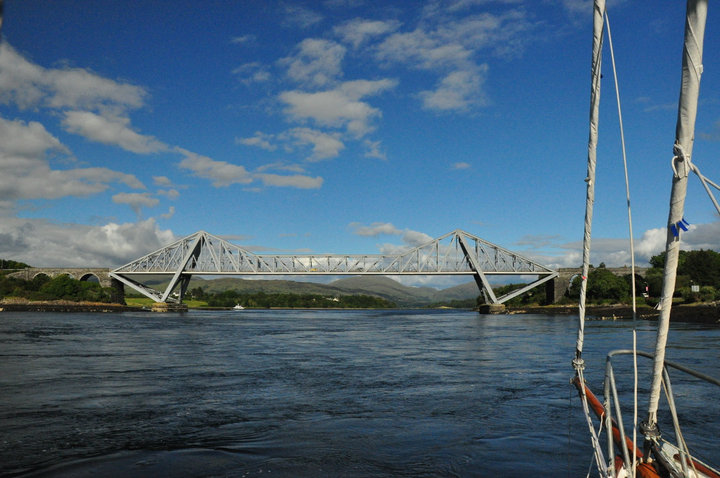
Now, dear reader, it would bear explanation here that the waters under the Connel bridge, known as the 'Falls of Lora', are among the most dangerous and violent anywhere in the world. The bridge itself has a maximum clearance of 14m charted, and with our air draft of 13.8m we decided to wait the afternoon out for low tide. Hitting the bridge was not a risk the skipper was about to take. Having arrived at the mooring at slack water, we were astounded that a mere 30 minutes later the sea under the bridge was a mass of white water the likes of which one only sees in rivers, whilst the water all around boiled and eddied with whirpools and eerie patches of calm. Watching leaves floating past the boat at great speed showed just how vicious the tide was here (8 knots, or faster than the Good Ship can ever travel). The reason for this phenomenon is the combination of the constriction of water under the bridge and a ledge under water which holds the sea up on one side 1.4 metres higher than the other as the tide flows past, meaning that the water actually FALLS over the ledge in the only salt water waterfall in the world. They are as veritable cauldron of white water for the majority of the tide, and far too dangerous to taverse until slack water. The usual traveller crossing the bridge would probably never notice the wonder going on beneath him, transfixed as most are by the view beyond the end of the bridge. But make no mistake, the Falls of Lora are indeed spectacular, and mystical in their ways. We were later told that local canoeists like to canoe into the largest of the whirlpools by the bridge, get sucked down to the bottom of the sea, from where they get shot along the seabed by the 8 knot tides before emerging 50 yards past the other side of the bridge. A neat party trick, I'd say.
We waited in awe at the spectacle of the Falls until the water suddenly went flat, and the torrents were replaced by a mysterious swirling and eddying. At this, we dropped the mooring and headed towards the bridge, aiming to line ourselves up with the small sub-strut between the first and second diagonal main struts off the starboard end of the bridge. 10 yards to the left, you hit the ledge. 10 to the right, you are on the rocks. No margin for error. It was no wonder that we later leaned that they see very few yachts up Loch Etive nowadays.
As we approached the bridge, the swirling eddies tried to turn us this way and that, and at the crucial moment the boat suddenly lurched hard towards the first of the Bridge's piers. Full throttle had us inching forwards at 1 knot whilst 5 knots of current tried to sweep us onto the rocks. The crew noted that they thought the masthead was about to hit the bridge above, but the skipper was too preoccupied trying to avoid foundering. The Good Ship finally wrestled herself free, with the skipper thanking the donkey before lining up the next set of transits to avoid yet more rocks. But the splendour of Glen Etive was opning out before us, and it was rapidly becoming clear why the authors Neil Gunn and Mairi Hedderwick had both proclaimed Loch Etive to be the finest of all Scottish Sea Lochs.
The loch winds it's way 20 miles into Lorn, with the narrows at the midpoint flanked by the majesty of Ben Cruachan and the beauty of Glencoe opening out beyond the head of the loch. It is little more than a mile wide, and very sparsely populated, with only a few very pretty houses and the odd castle along it's shores. We had a glorious sail up the loch in a light evening breeze, past the ruin of Archattan Priory where Robert the Bruce is said to have held the last Paliament in which the Gaelic language was used. Every turn in the loch's winding path offered stunning new vistas, and very few signs of civilisation until we reached our destination for the night, the old Iron working village of Bonawe. We were able to pick up a mooring, which was just as well given the plunging depths of the loch at this point, and after a quick sojourn ashore (where we learned from a local couple that very few boats ever came up the loch nowadays) we settled down under the light of the oil lamps to a well deserved supper. What a perfect day.
Day 6 - Puilladobhrain to Oban - the Bridge over the Atlantic - Sunshine!
A thin grey veil of early morning mist hung over the water when the skipper awoke at 8am and started preparing breakfast for the crew. We then loaded the little Seagull outboard motor onto the back of the dinghy and motored round to Dannsa na Mara to pick up Frank and Tanya, before ferrying everyone to the shore where we left the dinghy above the high tide line. The plan was to walk over the hill to the bridge at Clachan (village) which connects the island of Seil to the Mainland over a narrow gut of water which originated in the Atlantic Ocean (hence the bridge's more common name 'The Bridge o'er the Atlantic'). The day was warm and the breeze light as we made our way from the beach, through the marram grass to the path, which is signposted. A short but pleasant walk later and we were at the bridge, looking up and down the picturesque sound of Seil.
The bridge itself is a magnificent humped back stone arch built in 1793. At high tide, small boats can pass under the arch, which clears 12 metres. We were able to buy milk from the hotel at Clachan, and also look around the photo and art shops which, curiously, are unmanned save for an honesty box should you wish to buy something. After a short pause for photos, we made our way back to the anchorage, where we bid our final farewells to Frank and Tanya, before taking the opportunity to explore the shallows around the islets in the dinghy. Clumps of seaweed meant a fouled prop from time to time, but we were able to see some of the nooks and crannies that big boats cannot enter, and it was with some reluctance that we finally headed back to the Good Ship to raise anchor and head out to sea.
Once through the myriad of islets surrounding the anchorage, we set sail with one reef in the main and partly furled Yankee. It was a fetch towards the sound of Kerrera, and a building breeze made for sparkling sailing in the sunshine as we bowled along, the ship sailing with 'a bone in her teeth'. One of our neighbours in Puilladobrain was a Najad 400 which was motoring at full speed towards Oban on our track, and it's skipper took photos of us which, on meeting us later at Dunstaffnage, he promised he would email on at a later date.
As we entered the Sound of Kerrera, the wind dropped away and we motored the final mile or so to the visitors moorings off the Oban Sailing Club. We moored right next to the pontoon, ideal for jumping ashore from the dinghy, which we did in order to collect ship's stores and view the capital of the Western Highlands.
Oban is a thriving town which caters for holiday makers, fishermen and yachtsmen with a large range of Hotels, a Distillery, McCaig's Tower (an unfinished folly) up on the hill, and a good range of shops. We were able to replenish all the ship's stores, and even managed a SubWay 12inch Sub each, before returning to the boat early in the evening. The Skipper managed a shower on deck using the camping shower, no mean feat given the temperature of the water.
Seaman Finnegan proceeded to catch 7 mackerel using the line we had bought in Crinan Chandlery, and as night fell we barbecued them on the foredeck by the light of an oil lamp. The sky was filled with shooting stars as we ate like Kings, with the freshest fish possible. Oban had been kind to the fishermen on board the Good Ship.
Day 5 - Crinan to Puilladobhrain - The treacherous seas around the Dorus Mor - anchoring woes - perfect evening
Wednesday began with an early start to catch the tide through the Dorus Mor, a tight channel between the island of Garbh Reisa and Craignish Point. The pilot book notes that it is known "...not only for the strength of its tidal streams, but also for their complex and fascinating nature. Small whirlpools, patches of deceptive calm, swirls and overfalls are all present". The Dorus is the first of many tidal 'gates'up the West coast which must be met at the correct state of the tide (usually slack water, as the tide turns). It's nearby neighbour Corryvreckan can be heard booming from many miles away on Mull, and correct timing is paramount. The skipper had calculated that by leaving Crinan at 11.30am we would pass through the Dorus at slack water and carry fair tide (up to 6 knots) all the way up the Sound of Luing. But first we had to negotiate the final sea-lock at Crinan.
Overnight, a gentle breeze had sprung up, and having left the boat facing back along the path of the canal, the skipper now found himsself at the mercy of the Good Ship's inability to manouver under power in tight spaces, with the windage of the furled sails up front preventing him from making a 3 point turn in the tight confines of the basin. A line was lead ashore on which to pivot the bow around, although this was released just a moment too soon and the bow was blown off again. A great deal of frantic forward and reverse turning ensued, and finally the bow came round to the right direction, the bowsprit sporting some heather picked up from the opposite bank. The next boat in the lock, a smart 27 footer, had the same problem, so it was a lock full of relieved sailors that finally locked out of the sea lock and into the waters of Loch Crinan under a greay and menacing sky. But our woes were far from over...
We motored out into Loch Crinan over a grey sea beneath a menacing sky. The locking debarcle had made us nearly 2 hours late, and with the trusty 34HP Yanmar thrumming steadily away we pounded into the building wind and seas, spray flying off the bows with every dip. Brian and Melanie (friends from the boatyard) waved a 'hello' as they passed us going in the opposite direction onboard 'Alope', huddled together in the cockpit after their transit of the channel. We could see up ahead that the Dorus was in no mood to give us an easy passage through, and as we hit the tidal race the boat bucked violently in the confused, turbulent seas. The periods of 'deceptive calm' usually had the Dorus spinning the Good Ship in whichever direction she felt fit, whilst the short chop of the tidal overfall threatened to board the ship and take her to the bottom of the sea. The 27 footer that had accompanied us through the final lock ran for cover behind the island of Luing, whilst the boat ahead was suddenly doing 6 knots sideways as she hit the conveyor belt of tide heading North through the Sound. A number of dangerous rocks also had to be negotiated, a difficult task when the Durus seemed determined to sweep us onto them. We finally scraped through unscathed, the Dorus cackling evilly behind us as she spat us out into the Sound of Luing. moments later, we were doing 10 knots over the gound on the GPS as we heard Corryvreckan booming mercilessly in the distance.
Forgoing the sheltered pleasures of Cullipool, a labyrinth of sheltered backwaters behind the slate clad islets around Luing, we headed North past Pladda lighthouse, a lonely sentinel among the dark rocks and the grey seas. Soon the islands of Seil and Easdale were abeam. Easdale was formerly a slate-quarrying island, with a small population of miners living in small but sturdy houses which still exist today, along with a museum. The island also hosts the world skipping stone championships every year, the small shards of slate providing perfect stones for skipping on the calm waters of the Cuan Sound.
Passing the grassy hump of Insh Island, we turned in towards the top end of Seil, negotiating the slightly tortuous channel through the rocks and islets at the North end of the island which lead to the secluded anchorage of Puilldobhrain (Otter Pool), a favourite amongs visiting yachts for it's shelter and beauty. The anchorage was, as is often the case mid-summer, pretty busy, and it took a number of attempts to set the hook before we felt sure that we would not foul another boat if the Good Ship were to swing in the night. Seaman Farago wasted no time in setting off for the shore to take some stunning photographs, whilst the skipper and Seaman Finnegan lit the oil lamps and prepared supper. The scene was a stunning sight as the sun dipped beneath the distant mountains of Mull, reds, purples and yellows dancing off the ripples on the water. A lone otter popped his head above the surface, sniffing the evening air expectantly, before turning tail and swimming off beneath the clear waters. Outside the breeze moaned and the seas crashed mercilessly on the slate-rocks on the other side of the island, but we were snug in the anchorage for the night and glad to be there.
Day 4 - Cairnbaan to Crinan
Tuesday 10th August dawned warm and sunny, and it wasn't long before the Good Ship was again chugging away down the canal in the wake of Frank and Dannsa na Mara. The descent throught the canal was a good deal smoother than the trip to the summit, mainly due to the fact that the water is leaving the lock on the way down whilst entering it on the way up. Shipmate Farago prepared a great fried breakfast again whilst on the move, and it was a happy ship that made her way towards Crinan. The canal is superbly beatiful along it's length, especially so on the final descent to the Crinan basin. We passed through woods and fields, nature snuggling up against the boat on all sides, the bright white lock-keepers houses and neatly kept gardens providing further interest to the visual feast. One particularly wooded section lead to some swamplike by-lanes with a couple of small wooden cabins built on little islands. The first of these was a techni-coloured delight which could have been dreamed up by Hans Christian Anderson himself, being utterly gingerbrad house-like in appearance save for the multitude of different colours on every different piece of timber and pane of glass. A little painted sign titled 'Rainbow Island' completed the picture. A jolly middle-aged man emerged from the front door and called over how beatiful the Good Ship looked, and we returned the compliment about his house.
On arrival in Crinan, we decided to raft up alongside Dannsa na Mara for the night, and after a bit of 'this boat doens't steer in reverse' jiggery pokery we tied up facing the opposite direction, a decision that the skipper was to rue the following day. Showers were obtained from the Crinan Boatyard, a thriving, go-ahead sort of a place with many wooden boats in various states of repair adorning a traditional shed and slipway. Indeed Crinan itself consists mainly of the boatyard and the hotel, with less than a dozen homes to speak of but a beautiful and historic canal basin in which the Skipper's cousin Mike lives on his boat whilst commuting to work in LochGilphead.
After dinner, the crew headed down to the Crinan Hotel to meet with Frank and Tanya, and cousin Mike. True to form, Mike regaled us with tales of the canal (it seems that 'Rainbow Island' man washes naked in the canal...!!!) and of the various people and boats that he and Pat, his brother, had raced on over the years. The stories about 'bionic' yacht racing legend Bill Mackay were particularly well received, old Bill being impervious to the harsh cold of ocean racing after a number of operations following a racing car crash had left him without any perception of temperature. Very useful it would seem, at times. It was shortly after midnight and the canal was as placid as ever when the crew stumbled back to the ship and turned the glowing lamps down for a good night of well earned rest.
Subscribe to:
Posts (Atom)